


What Temporary Brand Spaces Reveal About How Businesses Build Recognition Beyond Traditional Advertising
May 26, 2026 | Business | No Comments
The Event Marketing Institute has reported that many consumers are more likely to remember brands after participating in live experiences rather than seeing traditional advertisements alone. That pattern reflects a larger change in how businesses compete for attention. People scroll through social feeds, pass digital billboards, and see advertisements throughout the day. Visibility remains important, yet visibility alone does not always stay in memory.
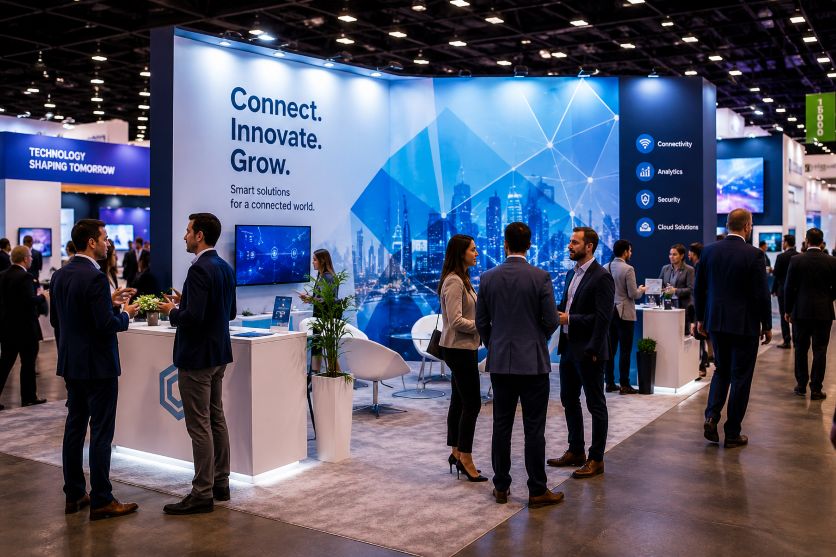
Businesses increasingly create short-term environments where people can interact with products, visuals, and ideas. Trade shows, launch events, branded installations, and conference booths have become spaces where organizations shape experiences rather than simply display messages. Industry examples involving backdrop printing NYC illustrate how temporary visual environments are often used as one element within larger event settings to create a recognizable identity for visitors moving through these spaces.
Why Traditional Advertising Faces New Challenges
Advertising has long played a central role in business growth. Television campaigns, print advertisements, radio placements, and digital banners continue to influence awareness. Despite their importance, modern audiences face a different environment than previous generations.
McKinsey & Company has observed that consumers now move between multiple channels and devices throughout the day. Attention becomes fragmented when people divide time between phones, computers, streaming services, and physical environments. Businesses therefore compete within crowded spaces where messages appear constantly.
Repeated exposure can increase familiarity, but repetition alone does not guarantee strong recall. A person may see dozens of advertisements during a commute and remember very few later that evening. These challenges underscore an important issue. Visibility and memory are connected, yet they are not identical.
Traditional advertising often creates passive interactions. Someone may see a logo or a message for several seconds and then move on. Temporary branded environments attempt to solve a different problem. They seek to place people inside an experience rather than asking them to observe from a distance.
How Temporary Brand Spaces Create Different Experiences
Temporary spaces appear in many forms. Some exist for one afternoon while others operate for several weeks. Pop-up stores, trade show booths, conference displays, and product launch events all belong to this category.
These environments create opportunities for interaction. Visitors may test products, walk through designed spaces, take photographs, participate in demonstrations, or engage in conversations. The goal is often less about immediate selling and more about creating memorable moments.
Harvard Business Review has discussed how customer experiences can shape long-term perceptions and emotional connections with brands. Human memory frequently responds to environments involving multiple senses. Visual design, movement, sound, and participation may contribute to stronger impressions than a static message viewed briefly.
Consider a technology conference where dozens of companies share the same exhibition hall. Every organization competes for attention under similar conditions. One booth might rely on a simple sign and table setup. Another may create an interactive environment using lighting, coordinated colors, display walls, and visual presentation elements that encourage visitors to stop and engage.
The difference extends beyond appearance. The environment itself becomes part of the communication process.
The Role of Physical Space in Memory Formation
Environmental design influences how people process information. Researchers in environmental psychology have long examined relationships between surroundings and human behavior.
The American Psychological Association has highlighted research suggesting that physical environments can affect attention, emotions, and memory. People often associate experiences with places. A product demonstration seen inside a visually organized space may become easier to remember than a product image viewed during routine browsing.
Several elements frequently appear across temporary branded environments:
- Consistent color themes
- Large visual displays
- Graphic walls and printed installations
- Interactive spaces
- Photo opportunities
- Clear visual storytelling
These features work together to create context around a brand message. Instead of seeing isolated information, visitors experience connected visual cues.
Businesses have increasingly adopted event graphics, branded display walls, and portable visual systems as practical tools within these environments. Large visual backgrounds can define space boundaries and create consistency within temporary settings where organizations have limited time to communicate identity.
Temporary Does Not Mean Short-Lived Impact
Temporary spaces may sound limited because they exist briefly. However, their effects sometimes continue after an event ends.
People frequently photograph experiences and share them through social media channels. A visitor may attend a conference booth for ten minutes and later post images that continue circulating online. One temporary installation can therefore create additional exposure beyond the original event.
Pew Research Center data indicates that visual content continues to play a major role in digital sharing behavior. Images often become part of broader conversations that extend beyond physical locations. Broader discussions around digital strategies and business growth patterns also show how organizations increasingly connect in-person experiences with online engagement. Businesses are no longer treating physical and digital communication as separate efforts. Instead, they often use each channel to strengthen recognition across multiple customer touchpoints.
Businesses increasingly understand this relationship between physical experiences and digital reach. A temporary installation may create direct interactions for attendees while generating additional visibility through shared content.
Despite changing technologies, people still respond strongly to environments that feel tangible and personal. Walking into a space creates a different experience from scrolling through a screen. The interaction feels more immediate because it involves movement and participation.
Looking Beyond Traditional Visibility
Businesses continue to rely on advertising across many channels, and traditional methods remain important within larger marketing strategies. Yet the growing use of temporary spaces suggests that organizations increasingly value experience as part of recognition building.
Trade show displays, visual presentation systems, branded event backgrounds, and large-format graphics represent more than decorative elements. They help shape how people experience a message and remember it later. The purpose extends beyond attracting attention for a few seconds.
Recognition increasingly depends on creating environments people remember after they leave. Temporary spaces reveal a broader shift in business communication, one where visual identity tools and event display solutions contribute to lasting impressions. Although the structures themselves may disappear after an event ends, the memory attached to those experiences can remain much longer.